 Exhibit
How do I authenticate text messages for court?
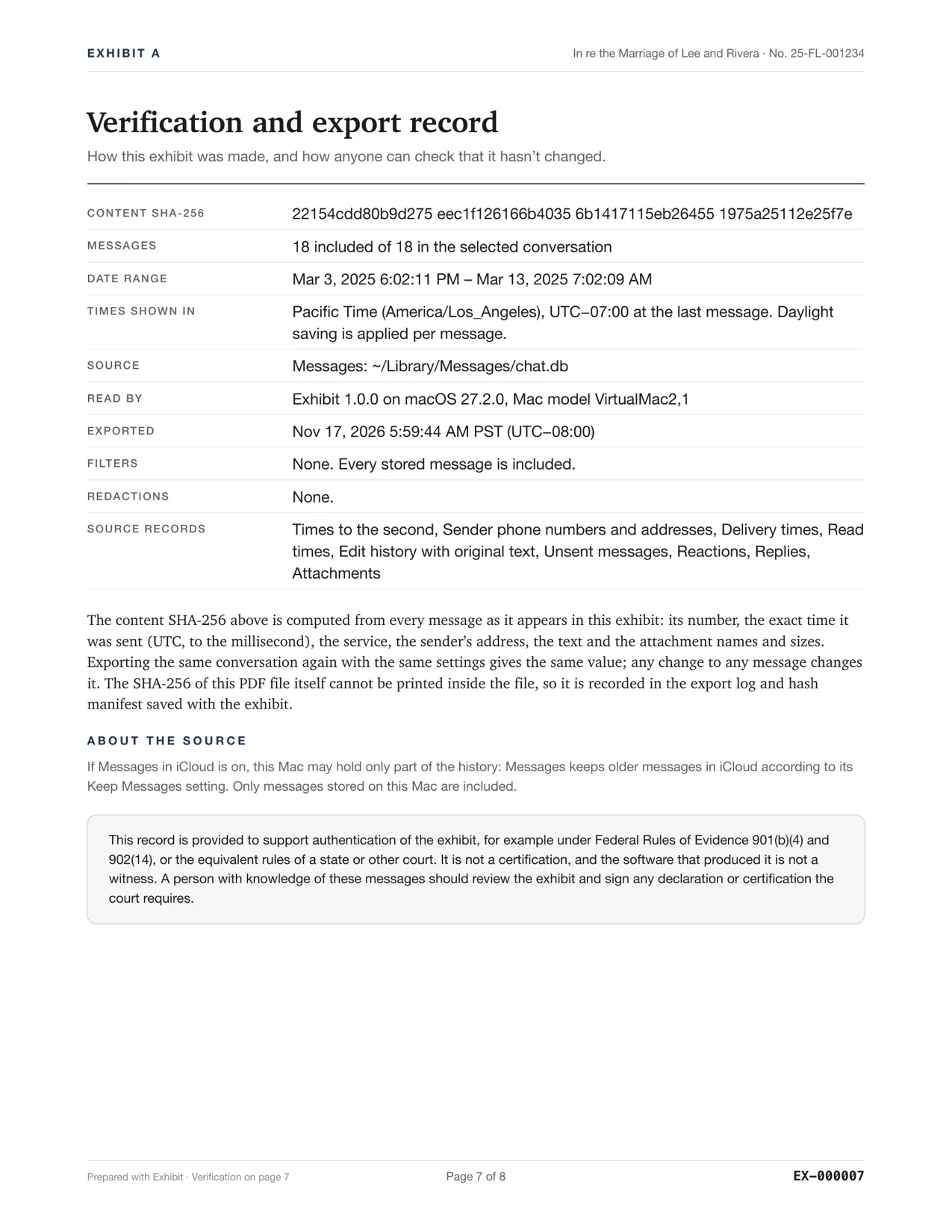
To authenticate a text message you show that it is what you say it is, usually by testimony from someone with knowledge, plus details that tie the message to the sender. Federal Rule of Evidence 901 lists ways to do this, and 902(14) allows a qualified person to certify an electronic copy by its hash value. Exhibit's verification page supports this; it does not replace the testimony or certification.
Updated November 17, 2026 · Not legal advice
What does authentication mean?
Authentication is the step where you show the court that an item is genuine: this is a conversation between Jordan Lee and Alex Rivera, these are the real messages, and they are shown as they were. Rule 901(a) of the Federal Rules of Evidence asks for enough evidence that the item is what you claim. Many state rules work the same way. Authentication is separate from whether the message is relevant, or whether the judge will let it in.
What are the usual ways to authenticate a text?
- A witness with knowledge, Rule 901(b)(1). You say you were part of the conversation, that this is your phone or Mac, and that the PDF matches what you saw.
- Distinctive characteristics, Rule 901(b)(4). The content, names, details only the sender would know, the phone number and what happened next can point to the sender.
- Certification by hash, Rule 902(14). A qualified person certifies that a copy of an electronic record has the same hash value as the original. It does not need a live witness for that step.
Which one fits depends on the case and the court. Many people use the first two together.
What does Exhibit add?
Each message carries its exact date, time and time zone and the sender's number. The PDF has a completeness statement, page numbers and message numbers. The last page, the verification page, shows SHA-256 hashes and an export record: when and how the exhibit was made, from which source, and what the source could and could not record. These details support authentication. They are not a certification.
What should my declaration say?
The sample exhibit ends with a fill-in declaration template for people representing themselves. A declaration usually says who you are, how you know the conversation, how you made the copy, and that it is a true copy of what the device held. It should say only what you know. Edit the template to match the facts, and have a lawyer or the self-help center look at it.
What about originals and duplicates?
The best evidence rules, Rules 1001 to 1004, deal with originals and copies. Under Rule 1001(d), a printout of data stored on a device counts as an original if it accurately reflects the data. Under Rule 1003, a duplicate is usually admissible unless someone raises a real question about the original. Keep your original conversation on your Mac and your iPhone backup, so you can produce it.
This is not legal advice. Courts and states differ, and a judge decides what is admitted. Rule 902(14) needs a qualified person's certification, and Exhibit does not provide one. Ask the court clerk, a self-help center or a lawyer about local rules before you file.
What can weaken authentication?
Gaps, edited screenshots, missing times, and unclear senders raise questions. A complete export with exact times helps. So does an honest note of limits, such as a source with no time zone, see exporting WhatsApp for court. For one point such as an edit, see proving a text was edited.
Questions
Does the other person have to agree the messages are real?
Not always, but a dispute makes your evidence matter more. If they deny a message, a complete export with exact times and numbers, plus your testimony, gives the judge something concrete to weigh.
Is a screenshot enough to authenticate a text?
It can be, if a witness says it is accurate and the court accepts it. It shows less, though: no time on each message, no numbers, and no way to check what was cropped. A data export shows more.